Remote cardiac monitoring has become the standard of care for patients with implanted cardiac devices. The 2023 Heart Rhythm Society (HRS) consensus statement recommends remote monitoring as the primary mode of follow-up for pacemakers, ICDs, CRTs, and implantable loop recorders — and Medicare reimburses this care through a specific set of CPT codes.
For cardiac device clinic managers and EP physicians, understanding which code applies to which device, what documentation is required, and how the 2026 updates affect reimbursement is essential to running a financially sustainable clinic. This guide covers CPT codes 93294, 93295, 93296, 93297, and 93298 in plain language.
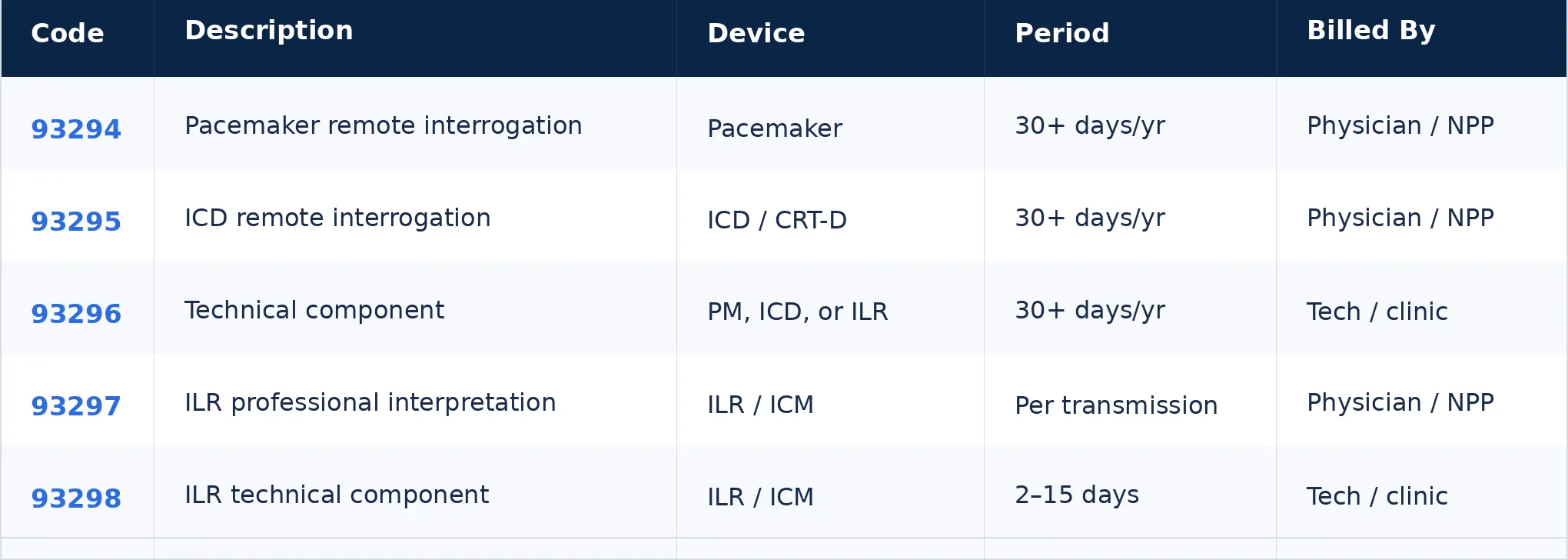
Quick Reference Table
CPT 93294 — Remote Interrogation of a Pacemaker
CPT 93294 covers the professional interpretation of a remote transmission from a single-chamber or dual-chamber pacemaker. To bill this code, a physician or qualified non-physician practitioner must review the transmission data, assess device function, and document a clinical interpretation.
The key requirement is that the remote monitoring service must occur over at least 30 days in a calendar year before the evaluation is billable. This is a per-period code, not a per-transmission code — meaning you bill once for the monitoring period, not for every alert received.
Common billing mistake: Billing 93294 for a single symptomatic transmission without meeting the 30-day minimum monitoring period requirement.
CPT 93295 — Remote Interrogation of an ICD
CPT 93295 is the equivalent of 93294 for implantable cardioverter-defibrillators (ICDs), including single-chamber, dual-chamber, and biventricular (CRT-D) devices. It covers the professional component — physician review and interpretation — of a remote ICD transmission.
Billing rules mirror 93294: a minimum 30-day monitoring period is required, and a physician must document a substantive clinical interpretation. Billing 93295 and 93294 on the same date for the same patient is not permitted.
CPT 93296 — Technical Component (Pacemaker, ICD, or ILR)
CPT 93296 is the technical component code billed in conjunction with either 93294 or 93295. It covers the infrastructure and support of the remote monitoring service — the system that receives, processes, and formats the transmission data for physician review.
In practice, 93296 is often billed by the entity that operates the remote monitoring platform, which may be the clinic, a clinical service partner, or a monitoring center. Octagos bills 93296 as part of its clinical service model, ensuring clinics receive the technical component reimbursement while Octagos handles the operational overhead.
CPT 93297 — Implantable Loop Recorder (Professional)
CPT 93297 covers physician interpretation of transmissions from an implantable loop recorder (ILR) or insertable cardiac monitor (ICM), such as the Medtronic LINQ or Abbott Confirm Rx. Unlike pacemaker and ICD codes, 93297 does not require a 30-day minimum period — it can be billed per transmission period when clinically indicated.
This makes ILR monitoring particularly valuable from a billing standpoint: a patient with frequent symptomatic episodes may generate multiple billable interpretation services per year. However, the physician must document a clinical interpretation for each episode reviewed.
CPT 93298 — Technical Component for ILR/ICM Monitoring
CPT 93298 is the technical component counterpart to 93297 for implantable loop recorders. It covers a 2-15 day monitoring period and is billed for the technical infrastructure supporting the ILR transmission service.
The 2026 Medicare updates reduced the minimum monitoring period for 93298, making it easier for clinics to qualify for reimbursement on ILR transmissions with shorter monitoring windows. This change is particularly beneficial for post-ablation monitoring and AF burden assessment.
How Octagos Automates CPT Code Compliance
Managing CPT code requirements across hundreds of patients and multiple device manufacturers is operationally complex. Octagos' Atlas AI™ automatically classifies each transmission by device type, cross-references monitoring period requirements, and flags billable events before routing them to the clinical review queue.
Key capabilities that support billing accuracy:
- Automatic transmission classification by device type and manufacturer
- Monitoring period tracking across all active patients
- 50%+ of non-actionable transmissions archived before human review — reducing workload without creating billing gaps
- Bi-directional EHR integration that pushes billing-ready documentation directly into your clinical workflow
- Bi-directional EHR integrations across every major platform ensure documentation reaches the right system without manual re-entry
Frequently Asked Questions
What is the difference between CPT 93294 and 93296?
93294 is the professional component (physician interpretation); 93296 is the technical component (the monitoring infrastructure). Both can be billed for the same monitoring period, but they are billed by different entities in split-billing arrangements — the physician bills 93294, while the monitoring service provider bills 93296.
Can I bill 93294 and 93295 for the same patient on the same date?
No. 93294 and 93295 are mutually exclusive — a patient has either a pacemaker or an ICD, not both (with rare exceptions). Billing both codes for the same patient on the same date will result in a claim denial.
Does remote monitoring qualify for RPM codes (99453-99454) in addition to CIED codes?
This is a nuanced area. CPT codes 93294-93298 are device-specific interrogation codes, while 99453-99454 are general remote physiologic monitoring codes. CIED remote monitoring typically bills under the cardiac-specific codes, not the RPM codes. Consult your billing team or Medicare guidelines for your specific payer contracts.
What documentation is required for remote monitoring billing?
At minimum: patient demographics, device type and manufacturer, dates of the monitoring period, a clinician interpretation note that addresses device function, programmed parameters, and any actionable findings. Octagos generates this documentation automatically and routes it through your EHR integration.