
The technology works. The challenge is what happens on the receiving end.
The platforms best equipped to handle that volume are the ones combining AI-driven filtering with clinical review rather than relying on algorithmic triage alone. This guide breaks down how each major platform stacks up.
A study published in JACC: Clinical Electrophysiology found that across a cohort of more than 26,000 patients with CIEDs, remote monitoring generated more than 82,000 alerts in a single year, highlighting the growing challenge of alert fatigue in device clinics.
Which platforms are actually built to handle that volume intelligently is what this guide is here to answer.
What Does Strong Alert Triage Actually Require?
Strong alert triage starts with one question: does the platform help your team act faster on what matters, or does it just deliver more data to sort through? The criteria below are what separate platforms built for clinical efficiency from those that simply relay transmissions.
Intelligent Filtering Before Alerts Reach a Clinician
The most effective platforms apply AI-assisted triage upstream, separating noise and false positives from transmissions that genuinely warrant review. This matters more than most vendors acknowledge.
Research published in JACC: Clinical Electrophysiology found that ILR false positive rates ranged from 46% to 86% depending on the indication for implantation, meaning clinicians at practices without upstream filtering are manually adjudicating transmissions that should never have reached them.
Acuity-Based Prioritization
Not every alert carries the same urgency, and a platform that delivers them uniformly forces your team to make that determination themselves, transmission by transmission. Strong triage tools arrive with that work already done, surfacing red alerts first and giving staff a clear, consistent queue rather than an undifferentiated inbox.
Single-Interface Workflow Integration
Most device clinics manage patients across multiple manufacturers.
A platform that requires staff to toggle between proprietary portals for Abbott, Medtronic, Boston Scientific, and Biotronik adds friction at exactly the wrong moment. Consolidated, single-interface access is a practical necessity for any high-volume practice.
Actionable Reporting Over Time
Trend visibility, documentation support, and performance reporting separate a genuine triage tool from a simple alert relay.
The best platforms give clinics the data they need to refine alert programming, identify high-burden device categories, and demonstrate outcomes over time.
How the Major Platforms Compare
Remote monitoring platforms fall into two distinct categories: manufacturer portals tied to a single device brand, and third-party aggregators built to consolidate data across all of them.
Manufacturer Platforms
Merlin.net (Abbott)
Merlin.net is one of the most widely adopted platforms in the field.
It offers reliable automatic transmissions, solid device compatibility across Abbott's CIED portfolio, and a report format clinicians generally find readable and consistent.
Where it falls short is filtering. The platform delivers alerts as generated by the device, with limited upstream intelligence to separate actionable transmissions from noise.
For practices managing large ILR populations, that gap compounds quickly at scale.
Latitude NXT (Boston Scientific)
Latitude NXT brings some meaningful advantages, particularly its connectivity monitoring, which tracks whether patients are transmitting on schedule and flags gaps proactively.
On alert triage specifically, alerts are organized by device and transmission type rather than clinical urgency. A practice managing hundreds of patients will still need internal workflows to prioritize what gets reviewed first, since the platform doesn't make that determination for you.
CareLink (Medtronic)
CareLink is the platform most device clinic nurses have the most experience with, given Medtronic's market share in pacemakers and ILRs.
It offers detailed diagnostic data and a reporting structure that maps reasonably well to clinical documentation requirements. The alert burden challenge is most pronounced here.
ILR false positive rates with Medtronic's Reveal LINQ under nominal settings ranged from 46% to 86% across almost 700 transmissions in a four-week period, and CareLink delivers those alerts without a filtering layer to reduce the load before it reaches staff.
Biotronik Home Monitoring
Biotronik Home Monitoring is frequently cited for its daily automatic transmission capability, which gives clinicians a more continuous picture of patient status than platforms relying on scheduled or event-driven transmissions.
That cadence is a genuine clinical advantage for high-risk patients. The tradeoff is volume.
Daily transmissions across a sizable patient panel generate a substantial queue regardless of whether anything clinically meaningful has changed, and the platform stops short of AI-driven prioritization that would meaningfully reduce that load.
Vendor-Neutral Platforms
Octagos
Octagos stands as the gold standard in remote cardiac monitoring, effortlessly bridging the gap between clinical precision and operational ease.
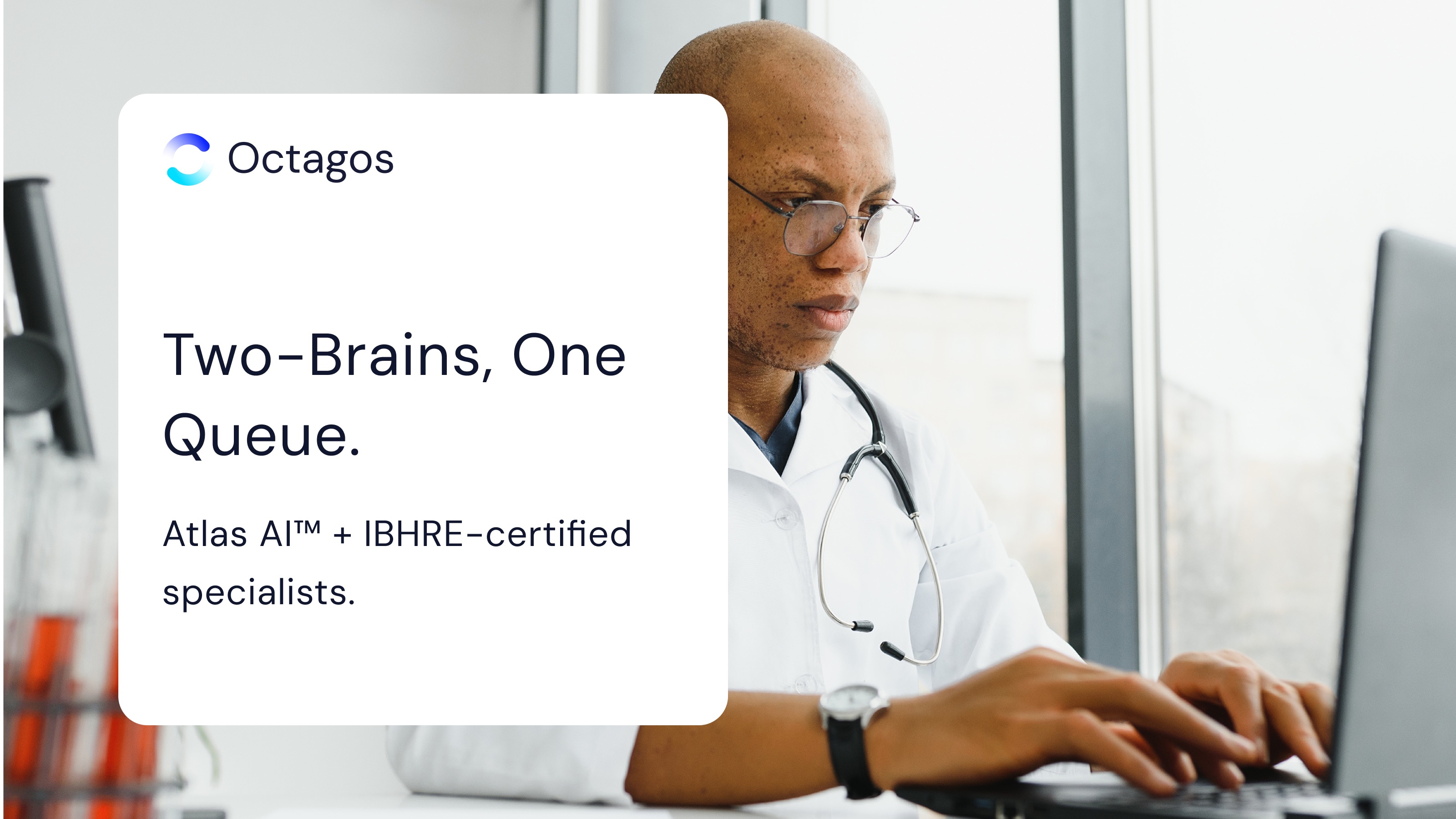
Built with proprietary Atlas AI™ and a unique "Two-Brain Approach™," the platform couples intelligent automation with IBHRE-certified specialist oversight to deliver an unmatched 99%+ clinical accuracy while filtering out up to 40% of non-actionable alert noise.
Unlike rigid alternatives, Octagos offers smooth, bi-directional EHR integration that deploys in an average of four weeks without disruption or hidden costly migration fees. Backed by its state-of-the-art OctaLink mobile app,
Octagos meets clinicians exactly where they are: providing a stable, deeply integrated, and truly comprehensive digital health ecosystem that competitors simply cannot match.
Murj
Murj focuses heavily on basic administrative workflow automation and digitizing documentation for multi-vendor practices. While it functions as an operational workflow tool, it entirely lacks advanced AI-driven alert triage capabilities. Because its software relies on standard, non-predictive logic, clinical staff are still required to manually sort through critical alerts. Furthermore, its scalability remains limited primarily to smaller clinic environments rather than enterprise-ready networks.
PaceMate
PaceMate relies on an 'Auto-Triage' engine to rank patients across 14 vendors, claiming it reduces alert fatigue.
However, its technology is tied closely to a legacy manufacturer footprint and rules-based filtering rather than advanced, dynamic AI.
Clinics frequently encounter lower flexibility and prolonged deployment timelines, often stretching across months or multiple quarters, making implementation slower and more resource-intensive compared to modern, highly agile environments.
Rhythm360
Rhythm360 heavily markets automated billing captures and fast response times, but its architecture demonstrates a notable lack of polished software maturity.
The platform relies on a rigid backend framework prone to introducing operational friction into daily clinical environments, such as disruptive update models that replace standard logins with cumbersome email links.
For clinics requiring a highly stable, seamless, and intuitive workflow, its infrastructure falls short of the modern industry standard.
How Octagos Atlas AI Approaches Alert Triage
Most platforms solve part of the problem. They consolidate manufacturer portals, automate documentation, or apply algorithmic filtering to reduce transmission volume.
What they don't do is put a trained clinical eye on alerts before they reach a physician.
That's the core of how Octagos approaches triage. Atlas AI applies an upstream filtering layer to incoming transmissions, but the platform doesn't stop there. The Two-Brain Approach pairs AI filtering with review by certified cardiac device specialists, meaning alerts are assessed by both machine intelligence and human clinical judgment before they ever land in a physician's queue.
The result is a smaller, higher-confidence set of transmissions that actually warrant action.
That distinction matters in practice. Algorithmic triage can reduce volume, but algorithms surface patterns. They don't make clinical calls.
When a transmission sits in a gray zone, a trained technician reviewing it before escalation is what separates a missed event from an appropriate intervention. Octagos builds that layer into the workflow by design rather than leaving it as an optional add-on.
The outcomes data supports the approach.
Results from Lehigh Valley Heart & Vascular Institute demonstrated meaningful reductions in non-actionable alert volume without an increase in missed clinical events, and findings published in JACC Advances validated the platform's ability to reduce alert burden at scale across real-world device clinic populations.
For high-volume practices and multi-health systems managing thousands of patients across multiple device types, that combination of AI filtering and clinical review is what makes triage scalable without sacrificing accuracy.
Choosing the Right Tool for Your Practice
The right platform depends on where your practice is feeling the most pressure.
If your primary challenge is managing multiple manufacturer portals, any third-party aggregator will get you most of the way there.
Consolidated access alone reduces friction significantly for multi-vendor practices.
If alert volume and false positive burden are the core issue, the evaluation gets more specific. Algorithmic triage helps, but the question worth asking any vendor is what happens when the algorithm is uncertain. A platform that escalates gray-zone transmissions directly to a physician without a clinical review step is transferring that burden rather than resolving it.
For large cardiology practices and multi-health systems where transmission volume is high, staff bandwidth is constrained, and the cost of a missed event is significant, the combination of AI filtering and human clinical review is worth prioritizing.
A few questions worth bringing to any platform evaluation:
- What is the cost of the platform & integration fee? Pricing in cardiac remote monitoring varies significantly with some vendors charging heavy integration fees as well as per patient fees.
- What percentage of alerts reaching physicians are actionable? Vendors should have data on this. If they don't, that's informative.
- How are gray-zone transmissions handled? Algorithmic confidence thresholds vary. Understanding what happens below that threshold tells you a lot about where staff burden accumulates.
- How does the platform handle cross-manufacturer data? Proprietary portals should be a dealbreaker for any practice managing devices from more than one manufacturer.
- What does implementation and ongoing support look like? A platform is only as effective as the team behind it. Clinical support, onboarding, and responsiveness to workflow issues matter as much as the technology itself.
See How Atlas AI Handles Alert Triage
Alert triage is where remote monitoring programs win or lose clinical bandwidth.
If your practice is managing transmission volume across multiple manufacturers and your staff is still making triage decisions the platform should be making for you, it's worth seeing how a different approach works in practice.
Book a demo with Octagos to see how Atlas AI and the Two-Brain Approach reduce non-actionable alert volume and surface what actually needs clinical attention.