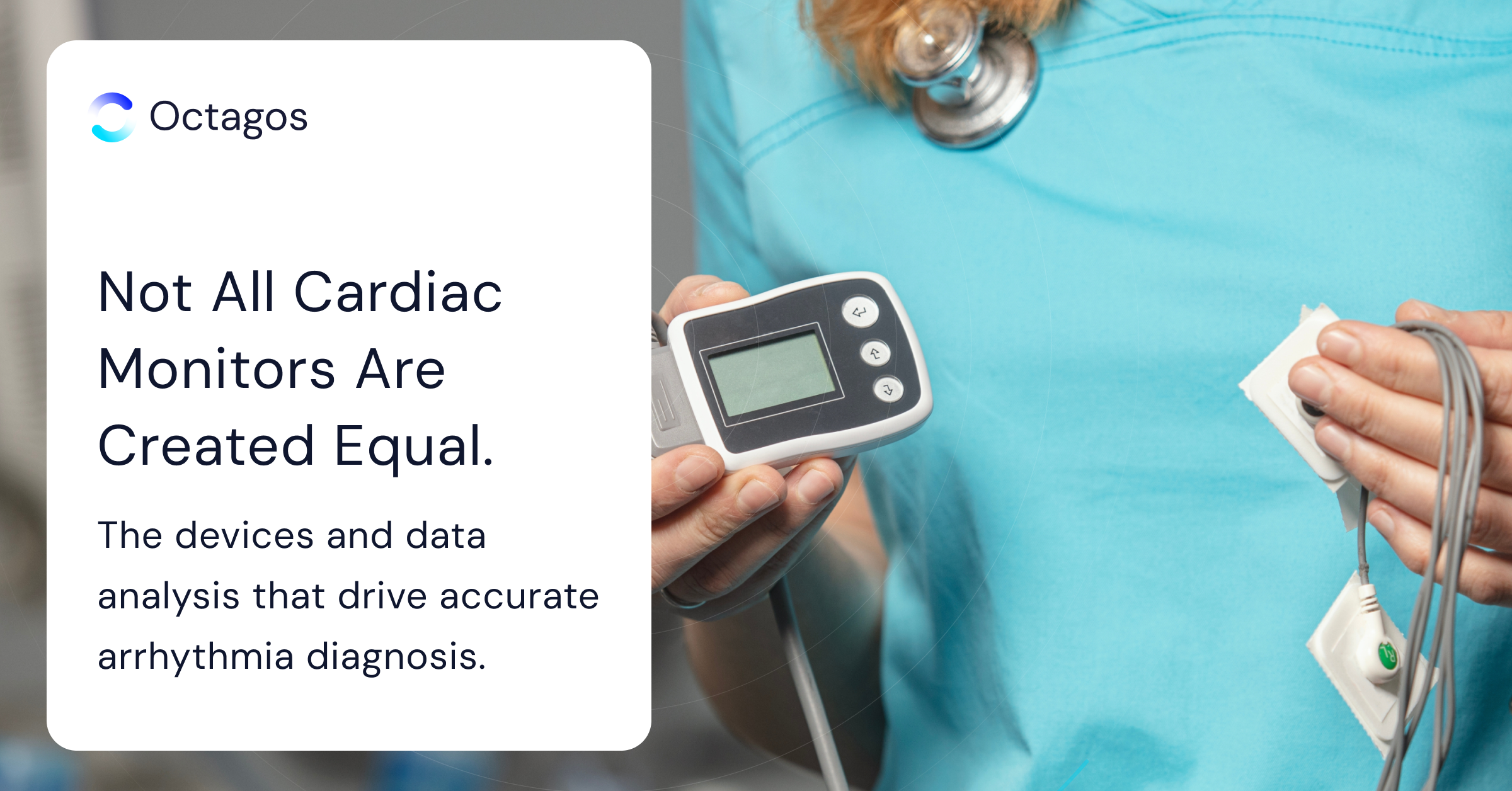
Not all cardiac monitoring devices are created equal.
A Holter monitor and an implantable loop recorder are both used to detect arrhythmias. Both fall under the broader category of cardiac monitoring services, but they serve very different clinical purposes.
Choosing the wrong one can mean weeks of inconclusive data and a patient no closer to a diagnosis.
Research has shown a significant percentage of high-risk arrhythmias, including non-sustained ventricular tachycardia, sinus pauses, and high-grade heart block, go undetected within the first 48 hours of monitoring.1
This is exactly why understanding the differences between device categories matters.
The Monitoring Duration Problem
Symptom frequency is the starting point for every monitoring decision.
A patient with daily palpitations needs a different device than one who has had three syncopal episodes in the past year. The core logic is simple: the monitoring window has to be long enough to capture an event.
That sounds obvious, but in practice it's easy to default to familiar tools. Holter isn't going to catch an arrhythmia that occurs once a month. Each device category in the ambulatory monitoring landscape exists because there's a clinical gap the previous one couldn't fill.
Understanding where those gaps are is what makes the difference between a monitoring strategy and a monitoring guess.
Holter Monitors
The Holter monitor is the most established tool in ambulatory cardiac monitoring, and in the right clinical context, still the right one.
It provides continuous ECG recording, typically over 24 to 48 hours, capturing every beat across that window without requiring patient activation.
When to Use One
Holter monitoring is best suited for patients with frequent symptoms, including daily or near-daily palpitations, presyncope, or known arrhythmias being evaluated for burden or treatment response.
It's also the standard choice for assessing heart rate variability, ST-segment changes over time, and pacemaker function.
Limitations
The 24 to 48-hour window is both its strength and its ceiling.
For anything less than daily symptoms, diagnostic yield drops significantly. Patients also have to return the device, which adds a logistical step, and lead-based systems can be uncomfortable enough to affect compliance over the wear period.
Extended-Wear Patch Monitors
Patch monitors emerged as a direct response to the Holter's time limitation.
Worn continuously for anywhere from 7 to 30 days, they record cardiac data without leads or a separate recording unit. Instead, they use a single adhesive patch applied to the chest.
For patients who find traditional Holter equipment cumbersome, the form factor alone tends to improve compliance.
When to Use One
Patch monitors are a strong choice when symptoms are infrequent enough to fall outside a 48-hour window but frequent enough that a two-week wear period should capture an event.
They're commonly used for palpitation workups, cryptogenic stroke evaluation, and AF screening in higher-risk patients.
Limitations
Most patch monitors store data locally and are analyzed after return, meaning there's no real-time visibility into what's happening during the wear period.
If a clinically significant event occurs on day three, the care team may not know until the device is returned. Skin irritation and adhesion failure are also recurring issues, particularly during longer wear periods.
Event Monitors
Event monitors are patient-activated devices designed for one purpose: capturing a rhythm strip when symptoms occur.
Unlike Holter or patch monitors, they do not record continuously. The patient feels something, presses a button, and the device logs the preceding and subsequent cardiac activity.
Some newer versions include auto-trigger algorithms that can detect and record certain arrhythmias without patient activation.
When to Use One
Event monitors are appropriate when symptoms are infrequent and unpredictable but recognizable enough that the patient can reliably activate the device.
They can be worn for up to 30 days, which extends the monitoring window considerably. They are a reasonable middle step before escalating to more intensive or invasive monitoring.
Limitations
The patient-activation model introduces real diagnostic risk.
Patients who are unconscious during an event, too symptomatic to activate the device, or simply unfamiliar with the technology will produce incomplete data. Asymptomatic arrhythmias will not be captured at all unless the device has a reliable auto-trigger function.
For patients unlikely to self-activate consistently, the diagnostic yield is limited regardless of wear duration.
Mobile Cardiac Telemetry
Mobile cardiac telemetry (MCT) is the most clinically intensive option in the external monitoring category.
MCT devices record continuously and transmit data in real time to a remote monitoring center, where trained analysts review incoming strips and flag findings for physician review. The key distinction from every other external device is that someone is watching the data as it comes in.
When to Use One
MCT is the right choice when the clinical stakes are high enough to warrant real-time visibility.
Patients with high-risk syncope, suspected malignant arrhythmias, or symptoms frequent enough to require immediate clinical response are strong candidates. MCT is also appropriate when prior monitoring with a Holter or patch has been inconclusive and the index of suspicion remains high.
Wear periods typically extend up to 30 days.
Limitations
MCT is the most resource-intensive option in the external monitoring category, both for patients and for the monitoring centers reviewing the data.
Compliance can be a challenge over longer wear periods, and the volume of incoming transmissions puts real pressure on clinical teams to triage accurately. The value of real-time monitoring depends heavily on the quality of the analysis on the receiving end.
A high-volume monitoring center managing alerts with limited clinical oversight can narrow that advantage considerably.
Implantable Loop Recorders
The implantable loop recorder sits at the far end of the monitoring spectrum.
It is a small subcutaneous device, roughly the size of a USB drive, inserted under the skin of the chest during a minor outpatient procedure. Once in place, it records cardiac rhythm continuously for up to three years, transmitting data automatically at regular intervals.
When to Use One
ILRs are indicated when external monitoring has failed to produce a diagnosis and the clinical question remains unanswered.
Unexplained syncope is the most common indication, particularly when episodes are infrequent enough that no external device is likely to capture one.
They're also used for cryptogenic stroke workups where AF detection is the primary goal, and for monitoring patients with known arrhythmia conditions over an extended period.
In one study, ILR placement to facilitate arrhythmia diagnosis found that 42% of patients who recorded a rhythm during symptomatic syncopal episodes demonstrated an arrhythmia, most commonly some form of bradycardia.2
Limitations
The procedure itself is a barrier for some patients, even as a minor outpatient intervention.
Battery life, while long, is finite, and extraction requires another procedure. ILRs also have a narrower diagnostic scope than external monitors in terms of signal quality and lead configuration. They answer the question of whether an arrhythmia is occurring, but with less granularity than a full external ECG recording.
How the Analysis Layer Has Changed
Choosing the right device is only half of the monitoring decision. The other half is what happens to the data once it arrives.
For most of the history of ambulatory monitoring, that meant a technician reviewing strips and flagging findings for the ordering physician. That model works, but it has well-documented limitations.
High transmission volumes, variable technician experience, and the sheer density of continuous recording data create conditions where clinically significant findings can be missed or delayed.
AI-assisted analysis has changed that calculus.
Octagos built its platform around this problem specifically, combining automated arrhythmia detection with physician-level clinical review through the Two-Brain Approach™ . The model pairs Atlas AI, which processes incoming data continuously, with expert human oversight on every flagged finding.
The result is a monitoring workflow designed to reduce both missed findings and alert fatigue, two failure modes that tend to pull in opposite directions.
For physicians ordering remote monitoring, the analysis infrastructure behind the device matters as much as the device itself. A 30-day MCT with a poorly resourced monitoring center can produce worse outcomes than a well-supported shorter-wear alternative.
The question is not only which device to use. It is who is watching the data, and how.
The Device Is Only Part of the Equation
The right cardiac monitoring device gets you the data. What happens next determines whether that data leads anywhere.
Octagos combines Atlas AI with expert clinical review on every transmission, so the findings that matter do not get buried in volume.
Learn How Octagos Works for Your Team
Sources:
- Incidence and timing of potentially high-risk arrhythmias detected through long term continuous ambulatory electrocardiographic monitoring - NIH
- Editorial: Wearable Devices for Cardiac Rhythm Monitoring - NIH